2,300 Volunteer Editors and One Support Hero: How NJFF Manages Its Digital Realm
How do you keep track of 560 different websites managed by over 2,300 volunteers with widely varying computer skills?
Written by Vegard Ottervig on
Bjørn Kristoffer Kjelsrud has a background from the mobile industry and e-learning, but since 2018 he has traveled around the country to provide support and training in the Norwegian Association of Hunters and Anglers (NJFF).
The organization, which has roots back to 1871, is democratically structured with 560 associations and 120,000 members. All of these associations have their own website, which creates a digital structure a little out of the ordinary.
A Massive Tree Structure
While NJFF centrally has its own web editor, Kjelsrud functions as the hub for the 560 subpages. The structure in the publishing solution is deep: It extends from njff.no at the top, via 19 regional teams, and all the way down to the local teams.
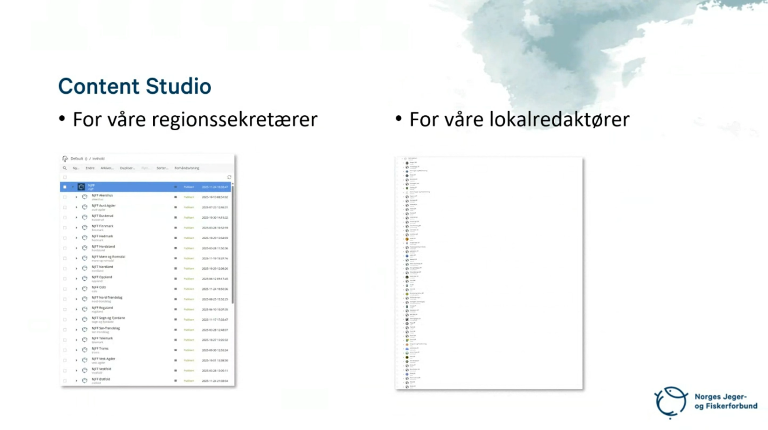
The scope is enormous. In regions such as Hedmark, which has over 40 local associations, the tree structure in Enonic is extensive:
From Enthusiasts to Beginners
To run this enormous network, almost 2,400 people have been assigned the role of editor. These are volunteer enthusiasts who spend their free time conveying the joy of hunting and fishing.
The competence among these varies greatly. You will find everything from extremely dedicated users to those who have barely touched a computer. Kjelsrud points out that it is a myth that the youngest are necessarily the best at publishing.
His experience suggests that being a web editor requires a different type of understanding than being good at social media such as TikTok. Often it is actually easiest to train those who have some general office experience and are used to standard word processing.
Read more: 10 Content Studio Tricks »
Support Strategy: Aid for Independence
Supporting such a large and diverse group that calls at all hours of the day – especially on weekends – requires a smart strategy. Kjelsrud has succeeded with three main measures:
- Facebook as a forum
He created a closed group for portal help which now has almost 2,000 members. This now functions as a self-propelled help forum where members relieve support by helping each other. - Video training
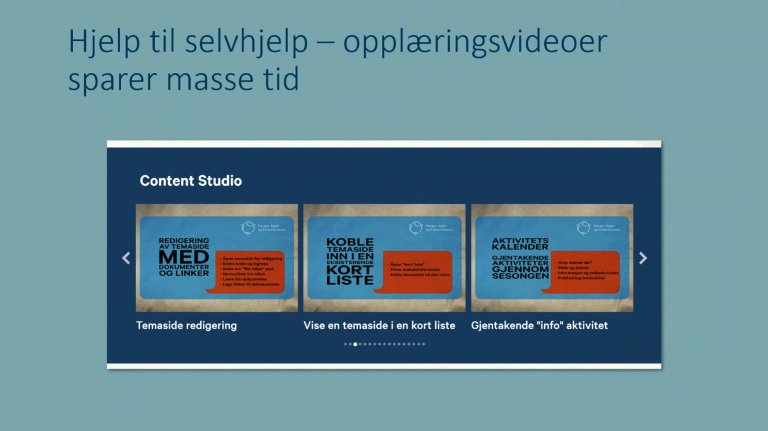
Instructive videos are uploaded to YouTube to ensure availability on all devices. These have become an important tool; Kjelsrud often experiences that people call him for help, while at the same time he hears his own voice in the background – the user is sitting and watching the training video while they are talking. - Personal follow-up
By saving the editors' numbers and knowing which association they are calling from, relationships are built. Kjelsrud experiences that being able to solve an acute problem in a short time for a desperate user creates great gratitude and motivation out in the organization.
The Battle for Content
Since the local associations are independent entities, NJFF centrally cannot dictate what they should publish. They must rather use incentives.
An example of this is the activity calendar. In order for associations to receive financial support for activities, the requirement is that the activity must be published in the digital calendar. This ensures that the tool is actually used.
Image use is another classic challenge. Many take pictures with their mobile in portrait format, often at arm's length. When these images are to be included in landscape format on the websites, you often end up with unfortunate excerpts where essential parts of the motif disappear. This requires continuous guidance.
See also: Content Studio 101 Videos »
Enonic Content Studio: Freedom within Frames
The transition to Enonic Content Studio has brought the organization together on one professional platform, and replaced a number of different solutions that previously lived their own lives locally.
The system is set up with templates that give editors access to specific components. Although this limits the possibility of technical errors, Kjelsrud observes that editors can be very creative in how they put the blocks together.
The trend is still positive. The number of inquiries about very simple problems is decreasing. When the phone rings now, it is more often about more complex issues. Kjelsrud interprets this as a sign that the training works, and that the system is experienced as logical once the users have cracked the code.