CMS 2030 – The Role of CMS in the AI Era
True digital disruption has barely begun. What will the world of digital experiences look like when the impact from AI becomes clearer? What will happen to the consumers? And what will the role of CMS be?
Written by Morten Eriksen on
We in Enonic recently arranged a workshop at our annual winter kick-off event, where the topic was “CMS 2030”. Four teams sat down and brainstormed what the role of CMS will be just a few years from now, and the common thread was remarkably similar.
Not surprising anyone, AI was at the top of mind of every team. But exactly how will AI continue to influence the world wide web and digital experience industry? What will be the role of content management systems when AI agents and swarms drastically change how we interact with businesses?
CMS As a Source of Truth
When using Google as a search engine nowadays, you often get an AI-generated answer to your question at the top of the search engine results page. This information comes from websites, with provided links if you want to look closer.
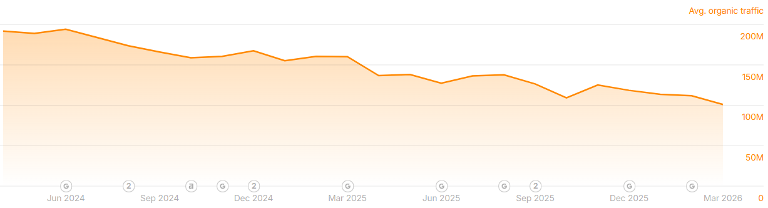
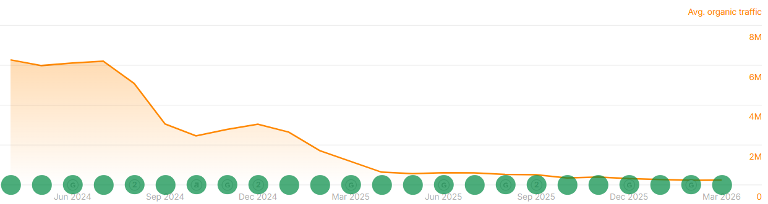
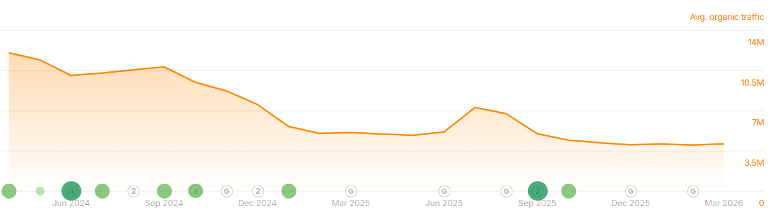
Many websites are experiencing a drastic fall in visitors, as AI agents act as intermediators and give us the answers straight, instead of us having to visit sites manually. AI assistants like ChatGPT and Claude go even further to present your knowledge, in many instances without references.
Even though the traffic almost disappears completely, the website (and by extension, the CMS driving it) must still be available as a source of truth to the various AIs and LLMs consuming your content.
Why is this important? Even with increased efficiency and speed of communication, we need to trust the information we receive as facts. The CMS acts like a gatekeeper in this matter.
Firstly, the quality of content in a CMS is assured by humans. A CMS with respect for itself includes an editorial workflow, content life cycle, version history, and more features to keep the truthfulness intact.
For instance, the Norwegian Directory of Health is entirely dependent on correct information about treatments, medicine dosages, and symptoms for its core users, the healthcare professionals. Similarly, the insurance company Gjensidige depends on valid data about insurance numbers and policies.
Without a source of truth, information from sites like these would essentially be worthless, even worse than the famous hallucinations of generative AI models.
We predict that the CMS will return to its roots and focus more on core CMS tasks supporting information veracity, like managing and structuring the reusable and curated content that is critical for your business.
Additional functions of today, like assisting in the front-end logic, URL management, and being an integration platform, will have less importance.
Structured Content, Now and Forever
For many years we have stressed the importance of structured content. In the face of a front-end agnostic omnichannel reality, it made no sense to tightly couple content and presentation as in traditional CMS.
But the craze for structured content and the decoupled headless CMS turned out to be just the beginning.
Sure, re-use of atomic content items across your website and even on third-party sites and apps was and still is a great benefit of structured content. But in the age of AI, the structured feature will be even more important.
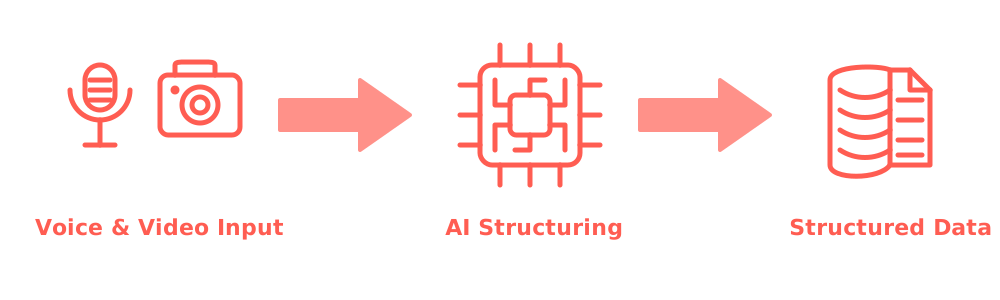
AI agents and other tools are essentially blocks of code that will still “look” for semantic and ordered data on the internet. The better your content is organized (and written, of course), the more likely it will be used for training LLMs and AI agents will pull out your data to display in search results or chat windows.
We foresee that a new role will emerge: the Content Architect. This isn’t just a writer or an editor, this is a person who understands the importance of structure, hierarchy, and metadata for your precious content.
APIs and MCPs
In the age of headless, APIs ended up on everybody’s lips. The quite mouthful “application programming interface” is a tool to make disparate services communicate with each other.
In our terms, an API makes your content talk to other distribution channels.
When AI tools are reshaping our digital behavior, it is essential that “everything” we have to offer is available. Open and flexible APIs make this happen, through a strong back-end service in the CMS.
The Model Context Protocol, or MCP, is becoming the AI era’s common interface for connecting models to content, tools and external systems. An MCP is a shared plug that lets an AI connect to apps, data, and tools in the same simple way. Like USB for AI.
Where traditional APIs expose functions for developers, MCP makes it easier for AI services to discover, understand and use what is available.
For a CMS, that means content must not only be open, but structured and accessible in ways assistants and agents can work with directly.
See what an MPC can do in practice for a CMS:
We therefore think there will be a shift from front-end to back-end. Front-end, with its developer-friendly and app-like end user experience, has dominated the industry the last few years.
But soon the back-end will return with a vengeance, and the front-end will be powered mostly by AI.
The Fate of the Front-end
With the CMS going back to its back-end roots and essentially acting like a data source in the face of AI, where does that leave the front-end?
Take personalization, for instance. AI agents will “remember” your context and have custom instructions, effectively replacing the front-end personalization of today.
The front-end developer role will thus be redefined, as a lot of their previous tasks will be handled by AI models.
Already, many developers are starting, not with a blank editor, but with a prompt.
Tools such as Lovable and v0 let teams describe an interface in plain language, which generates working components and layouts. It also connects to databases and APIs, and publishes prototypes in minutes.
The AI writes much of the syntax, while the developer directs the logic, the structure and the quality.
This changes the craft from drawing pages to designing ecosystems. Developers will spend less time assembling fixed layouts and visuals, and more time shaping data structures, APIs, agents, MCPs, and design systems.
Fragmented data will preserve identity thanks to these systems. This will come in handy when the traditional website shifts from a visual page visible to the human eye to many small, temporary and AI-generated micro-interfaces.
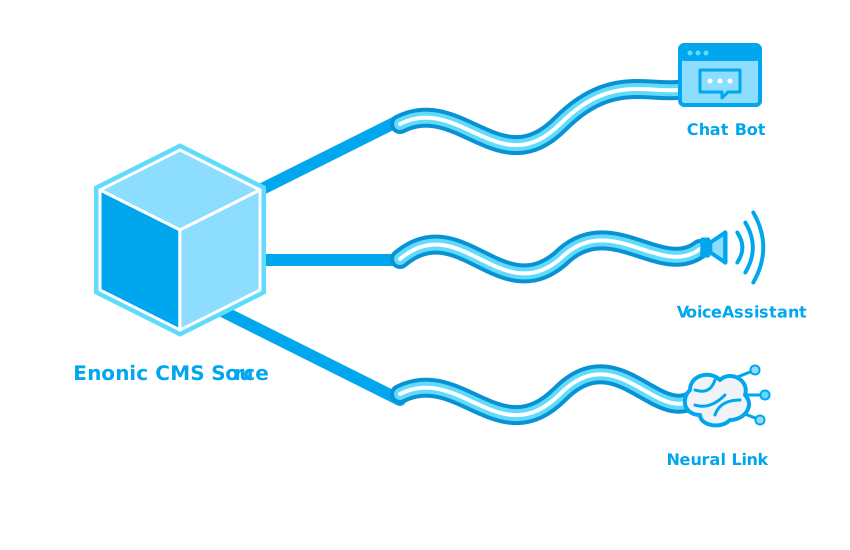
The output may still be a web page, or more likely a voice response or a synthesized answer from an agent, but the consistency and source of truth must come from the system behind it. That is, the CMS.
From Creation to Orchestration
Let’s see where we are so far:
- AI replaces ordinary search results and website visits
- CMS will be a source of truth to be consumed by AI
- Structured content will help you manage all your content and ensure the AIs consume and train on your data
- APIs and MCPs will help your content be available
- Parts of the front-end will be replaced with AI
- The rest of the front-end will be built using AI
Up until now, we have had decades to populate the internet with content—with data. There’s so much information out there that even the AI gets a headache.
In many cases, it makes more sense to orchestrate your existing content instead of just creating new. Yes, sometimes a news article must be published, but a lot of the time it is equally or even more important to organize the gold mine we already sit on top of.
Most brands don’t need to start from scratch content-wise. In the age of AI and structured content, we recommend integrating and increasing the quality of your content.
The future CMS will be used increasingly to, not only create, but to aggregate and fetch data from other sources as well, to curate and make meaning out of vast bodies of information. For both the AI agent and our own convenience.
We think the CMS of 2030 will focus more on processes to enforce quality, security, version history, and robust workflows. Being the ultimate Source of Truth for your digital channels.
So, in conclusion, the CMS isn’t going anywhere anytime soon. Yes, it will be different than before, but that’s nothing new.