What Does AI Learn from Your Content?
AI doesn't just need more content. It needs the right content. Before you connect chatbots, smart search, or internal assistants, you should know what AI is actually learning from.
Written by Amanda Kloster on
Many businesses are now testing AI in the form of chatbots, smart search, and internal assistants. But before AI gets access to your content, you should ask one important question:
What are we actually asking the AI to learn from?
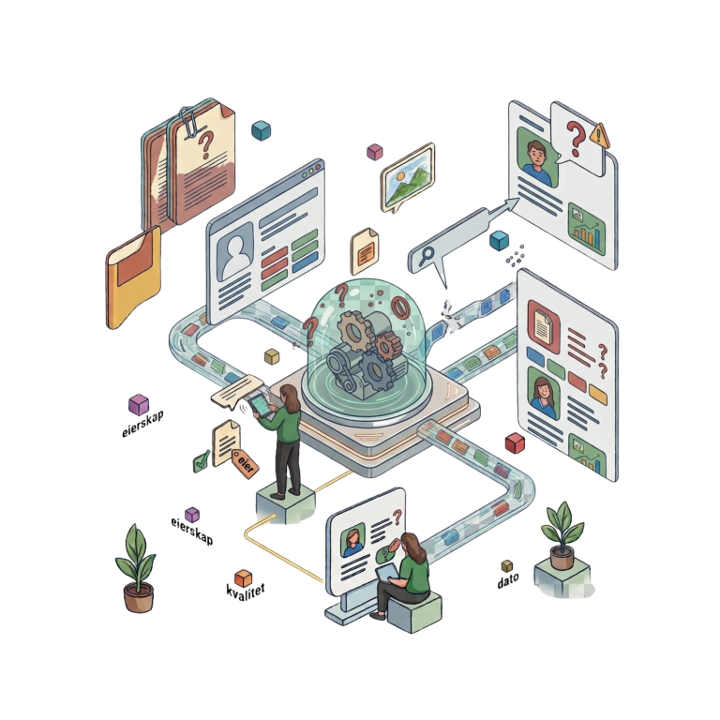
AI does not always distinguish between old, nearly correct, and approved content. It can pull from outdated PDFs, old web pages, internal drafts, or documents that were never intended to be the source of truth.
In that case, the problem is not necessarily the AI. The problem is the content it is built upon.
More content does not always mean better answers
It can be tempting to give AI access to everything: the entire intranet, all documents, old archives, and product information.
But more content also means more opportunities to choose the wrong source.
If the same information exists in multiple versions, if old documents are still searchable, or if no one knows what is actually approved, the AI can provide answers that seem correct — but are not.
That is why AI projects should start with cleanup, not just access.
Start where errors can have the greatest consequences
You don't need to clean up everything at once. Start with the content where incorrect answers matter most.
This could be prices, terms and conditions, deadlines, opening hours, procedures, product details, or professional recommendations.
A good question to start with is:
Which content do we absolutely not want the AI to answer incorrectly?
That is where you will often find the most important candidates.
Look for content the AI should not use
Some content should not be the basis for AI answers.
This applies, for example, to old documents, archived pages, drafts, internal notes, previous campaigns, or content without a clear owner.
Before AI is connected, the business should know:
- what is approved content
- what is outdated
- what is still a work in progress
- who owns the content
- when it was last updated
This makes it easier to distinguish between content the AI can trust and content that should be cleaned up, updated, or removed.
Test what the AI actually finds
Don't evaluate the content only in theory. Test which sources the AI actually uses.
Ask questions that users are likely to ask. See if the answers are based on updated and approved content — or if the AI finds old, weak, or contradictory sources.
Perhaps an old PDF appears before the updated page. Perhaps an internal text gives a different answer than the website. Perhaps the same question has several different answers.
Then you have found a content problem that should be solved before AI is used more broadly.
How Enonic can support this work
Enonic can help businesses gain control over which content is published, updated, approved, and ready for use.
With content types, workflows, roles, permissions, versioning, and publishing control, it becomes easier to distinguish between content that can be used safely and content that should be updated or archived.
Clean up before you automate
AI can make content more accessible. But it cannot automatically know which of five nearly identical texts is the correct one.
That is why businesses should clean up before they automate.
Start with the content that matters most. Remove old versions. Mark what is approved. Clarify ownership. Test what the AI actually uses as a source.
Then you are not just giving the AI more content. You are giving it better content. And that is the difference between fast answers and correct answers.