From Searchable to Quotable: How to Prepare for the AI Wave
Does AI change the way we find, understand, and interact with online content? Does it also change how we work with SEO? What is wise to consider going forward?
Written by Vegard Ottervig on
Search behavior has fundamentally changed. We are moving from hunting for links to expecting ready-made, compiled answers.
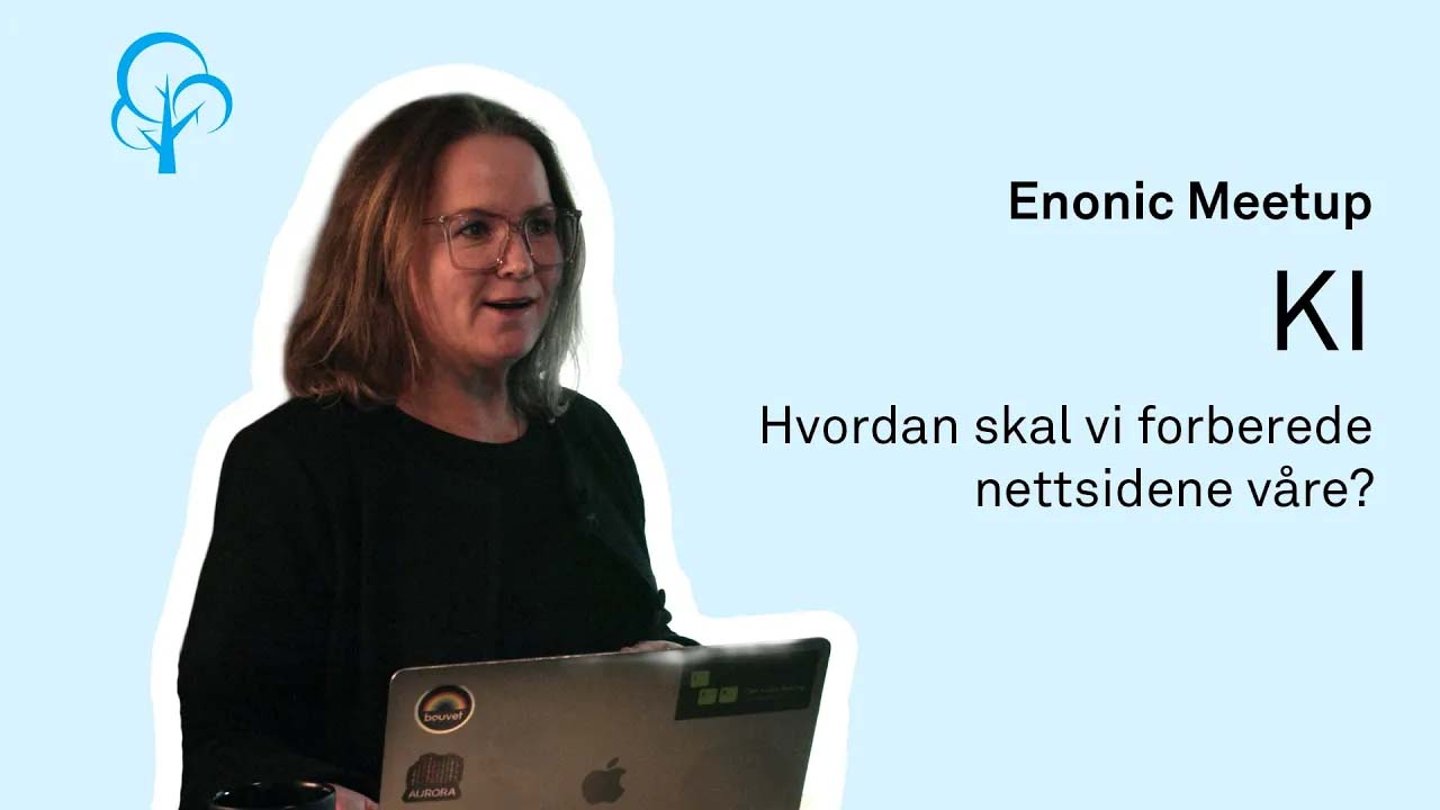
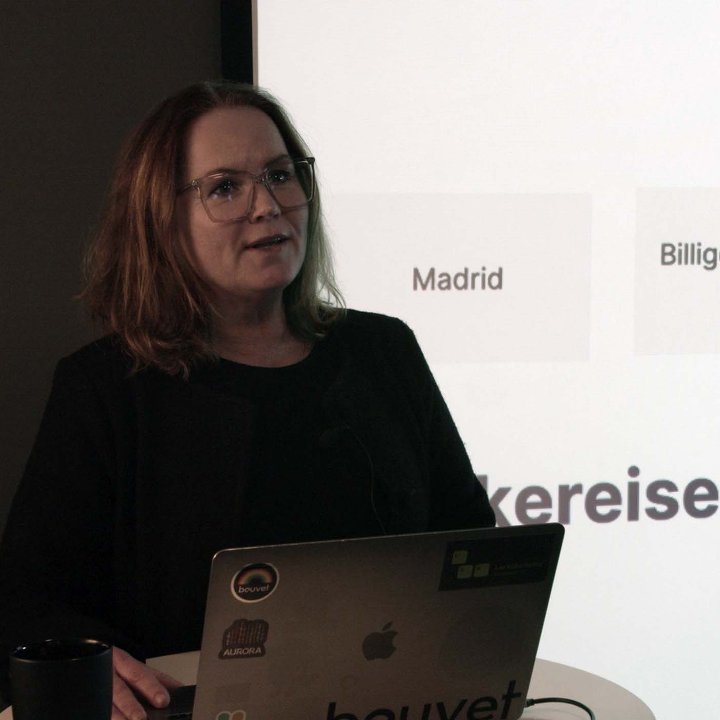
Recently, Henriette Høyer, Communications Director at Bouvet, gave a lecture at Enonic. She believes that it is no longer enough to just be searchable – now the content must be quotable.
With 25 years of experience in digital communication, from her time as a web editor at NSB to her current role at Bouvet, Høyer has seen many technological shifts.
She now leads the work of adapting Bouvet's digital surfaces, which run on Enonic, to a reality characterized by artificial intelligence.
From Keywords to Intention
To understand the change in search behavior, Høyer points to how we plan trips. While we previously searched for single words like "Madrid" to find general articles, or "plane tickets" to find prices, today's requests are far more complex.
Now, users often ask for a complete itinerary with specific criteria for hotels, transportation, and attractions in one operation. Search engines and AI agents understand the intention behind the question and can increasingly connect data from various sources – and even perform actions on behalf of the user.
When the Journey Ends Before the Click
This development creates a challenge for content producers: Tools like ChatGPT, Perplexity, and Google Gemini do the grunt work for the user. They read, interpret, and summarize the information.
The consequence is that the user journey often ends before the user even clicks on the website. According to Høyer, this does not mean that the website has lost its value.
On the contrary, it is more important than ever as the very source, or "witness of truth," from which the AI models draw their knowledge. For AI to generate good answers, it depends on companies continuing to publish content with high quality and substance.
See also: We Are Testing Our Own AI Translator »
AIO Builds on SEO
Høyer emphasizes that the transition to AIO (Artificial Intelligence Optimization) does not require throwing everything you know about search engine optimization (SEO) overboard.
If you already have good SEO routines, the foundation is in place. The AI models prioritize content that is thorough, up-to-date, and professionally sound.
Bouvet's strategy for becoming "AI-friendly" revolves around five main points:
- Quality and depth: The content must have professional weight.
- Natural language: The texts should be optimized to answer natural questions.
- High specificity: It is not enough to be general. A product description must be detailed enough to match users' increasingly specific search intentions.
- Credibility (E-A-C): It is crucial to highlight experience, expertise, authority, and credibility. AI looks for sources with a clear sender.
- Reputation: Third-party reviews strengthen credibility. When the content is confirmed by other sources, the chance that AI will choose to use it increases.
Universal Design As a Competitive Advantage
An interesting point Høyer makes is that artificial intelligence can in practice be regarded as a new type of user with special needs.
This means that the work with universal design (UD) gets double value. Clear language, logical structure, good headings, and correct metadata make the content accessible to people with disabilities, while making it easier for machines to understand and categorize the content correctly.
Read more: Accessibility in Enonic »
"Too Long, Didn't Read" Is Over
As a knowledge house, Bouvet lives by making the expertise of its over 2,300 employees visible. Previously, the rule of thumb on the web was to write short and concise because readers were short on time.
To be picked up and quoted by AI, Bouvet has now turned things around. They see that they have to write longer and more comprehensive texts to give the AI models enough "food" to understand the complexity of their deliveries.
To balance this against human readers' need for quick information, they have introduced a fixed structure with "Briefly explained" at the top of their reference projects. Here, challenge, solution, and value are summarized point by point.
This functions as an effective summary for busy people, while serving the AI models a pre-structured overview that is easy to quote correctly.
Quality Over Volume
Many marketers fear traffic drops when AI gives the answers directly in the search result. Høyer, however, takes the development calmly and focuses instead on the quality of the traffic.
The reasoning is that fewer visitors are acceptable, as long as those who actually click through are more qualified and genuinely interested.
In conclusion, the advice from Bouvet is clear: One must not fall into the trap of optimizing only for the machines. The main focus must still be on creating good user experiences for people.
If you succeed with that, you will in most cases also succeed in being understood and prioritized by artificial intelligence.