
Precision on the Dot: How SSB Manages the Nation’s Most Important Figures
When managing the nation's most important figures, there is no room for error. For Statistics Norway (SSB), it's about public trust, split-second precision, and technical integrations that can withstand heavy loads.
Statistics Norway (SSB) is the very foundation for figures and statistics in Norwegian society. As an administrative body under the Ministry of Finance and the Statistics Act, their mission is to produce official statistics on everything from national accounts and price inflation to population figures and the labor market. The agency has deep roots, having been established in 1876, and will celebrate its 150th anniversary in 2026.
Digitally, SSB is a pioneer. The website ssb.no was launched as early as 1996 and was one of the first major public web portals in Norway. Today, the website is a massive source of information where “name search” is the most popular service for the general public, but where the real value lies in the deep integrations with the Statistics Bank and the 300 active statistics that form the backbone of Norwegian societal planning.
Challenge: Precision Under Pressure
When SSB publishes statistics, it's about more than just releasing information. The state administrative body is legally obliged to have full control over the data flow.
Integration and Presentation of Data
The heart of SSB’s operations is the Statistics Bank. Most of the data on ssb.no is retrieved from here, and the challenge lies in extracting reusable content from complex data stores and presenting it in an understandable way.
This requires a seamless connection between raw data and the visual elements the user encounters on the website, whether it's tables, graphs, or key figures. There are over one million pages and an enormous amount of content, including 900 published articles annually in addition to the regular statistics. Navigation and structuring is thus a constant balancing act between depth and user-friendliness.
The Sacred Hour: 08:00
Some important reports and statistics from SSB include national accounts, wage statistics, the consumer price index, retail turnover, population statistics, social security and social statistics, tax statistics, and waste and resource use.
Equal treatment is an unshakeable principle for SSB. Unpublished figures from reports are strictly confidential until they become public, and many actors, from banks and analysis agencies to newsrooms and government bodies, are ready to act the second the figures are released.
This means that all content must be published exactly at 08:00. A delay or an early leak is not just a technical deviation, but a breach of SSB’s mandate.
The management of confidential information also means that only the right professionals and employees should have access to the right unpublished content at all times.
Solution: An Architecture Built for Speed and Facts
To meet these requirements, SSB, in collaboration with Item Consulting, has developed a solution that fully utilizes Enonic’s flexibility.
Data Model
SSB has built a data model where statistics are treated as objects in Enonic’s node tree, which can be viewed through the Data Toolbox. The HTML tables from the data are parsed into JSON, which is a lightweight, text-based format for storing and exchanging structured data.
The model includes a “DataSource” mixin. A “mixin” in Enonic is a reusable collection of fields (schema elements) that can be included in content types or components.
With DataSource, editors can paste numbers from Excel or retrieve them dynamically from the Statistics Bank via a “listener” that always ensures that the latest version of the dataset can be published manually where it is not done automatically.
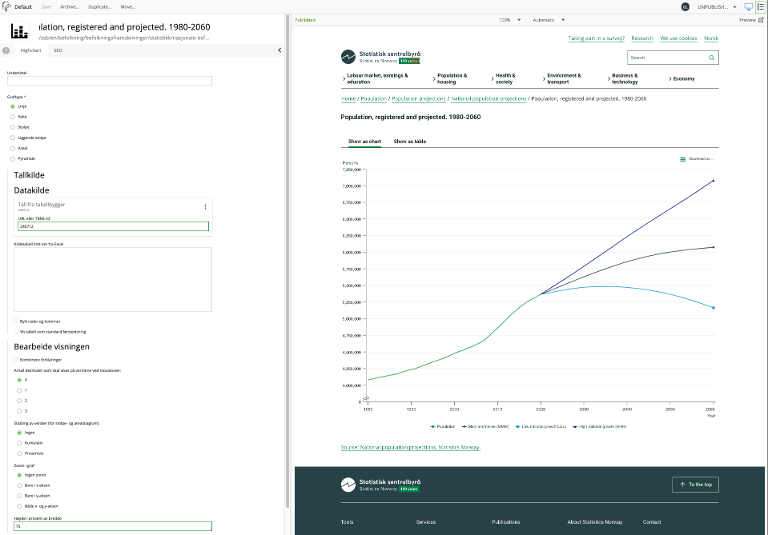
An example of statistical data is population forecasts. Here, SSB retrieves data from a specific dataset in the node tree via a unique ID in a field in the content type.
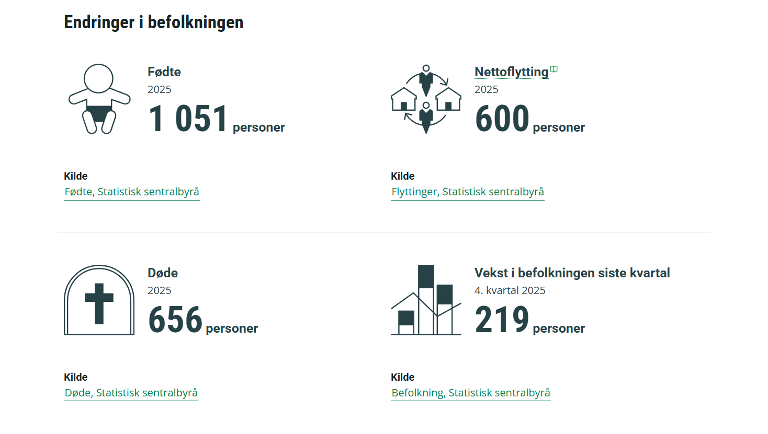
The front page of ssb.no mainly displays content from components published elsewhere on the website. All new updates of figures are retrieved from the Statistics Bank and displayed on the front page and other pages by running daily jobs.
All pages are built in the Content Studio editor interface. The municipality fact pages, for example, include dynamic data from all municipalities, population figures, in-migration/out-migration, births/deaths, income, and so on.
Highcharts Integration
The data on ssb.no is visualized using the Highcharts integration. Highcharts is a Norwegian-developed JavaScript library for creating interactive charts and data visualizations on websites.
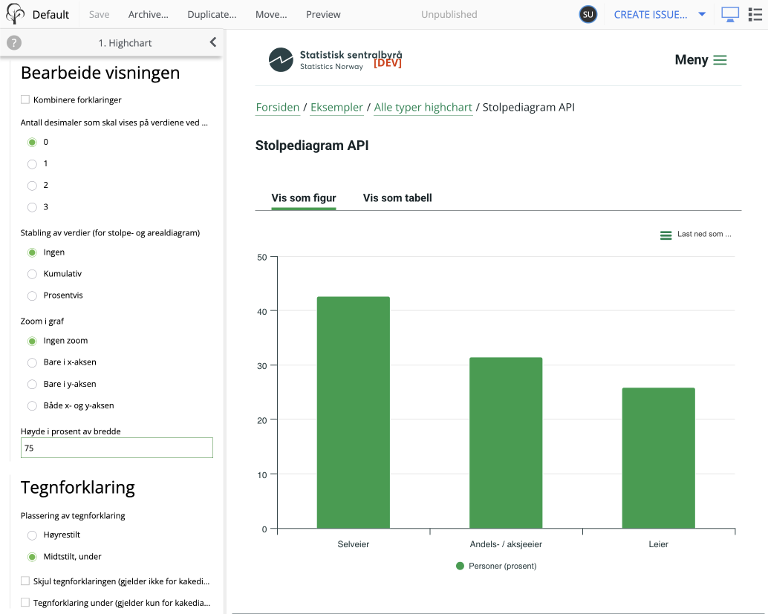
With this integration, editors can configure graph types in Content Studio, while the system ensures that the interactive graphs always display the latest figures.
The integration is intended to be as simple as possible for all internal users. Certain limitations have been placed on configurable fields, for example, which makes the choices less overwhelming and leads to a more user-friendly experience. At the same time, this ensures a uniform expression in line with SSB's brand.
How They Cracked the 08:00 Code
To ensure that all relevant statistics go live exactly at 08:00 without buckling under traffic peaks, SSB uses a sophisticated caching strategy. All content is pre-published to the “master” branch in Enonic approximately 10 minutes before final publication.
SSB uses caching technology from Vinyl Cache with Enonic and has implemented an EventListener that monitors changes.
The moment the clock strikes eight, only the specific pages in the cache are invalidated. This means that the first user who hits the page triggers an update, while subsequent users are served the fresh figures lightning fast from the cache.
Security and Review
The handling of confidential, unpublished data requires a strict review process and advanced rights management.
Content is divided into unique rights groups in Enonic, so that statisticians can only view and edit what they themselves own. The system guarantees that “secret” figures remain secret in the CMS until the publication time.
Editorial Workflow
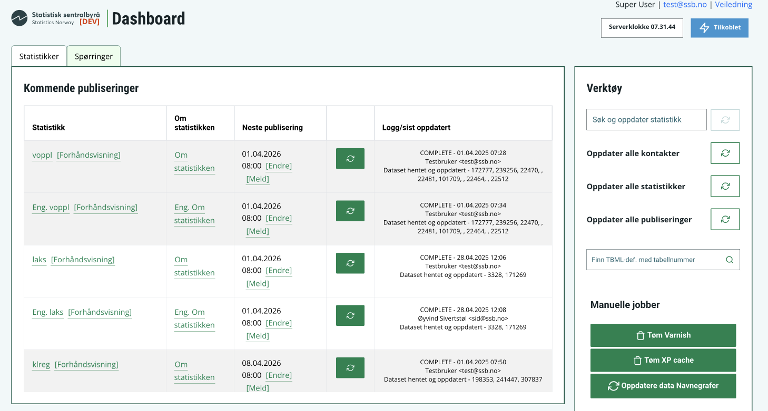
SSB has decentralized content management with over 100 users. To keep track of everything, they have developed a dedicated dashboard in Enonic that collects links to back-end systems and provides an overview of all upcoming publications.
SSB announces statistics publications three months before the publication date. Via the dashboard, the entry of new dates or changes to announced dates is managed.
From the dashboard, users can jump directly into the content in Content Studio. This is role-based, and people from different subject sections can only see their own areas.
On the dashboard, statisticians can further “spin” (update) the figures and use macros to insert fact boxes and graphs directly into the body text. They can also see a preview before sending them to the central desk for final approval.
Decentralized publishing and editing has been positively received by users. Statisticians and editors particularly like being able to see a preview of the content they manage at all times.
Smart, Reusable Text
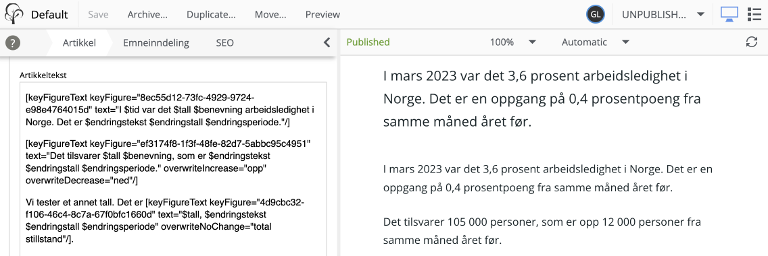
SSB has created code to introduce automatic content updates in both body text and components. You can retrieve code from a component with statistics and use it as text in a sentence. For example, “There was a decrease of 2.3 percent.” When the figures in the statistics bank change, the body text is automatically updated.
SSB has just under 40 fact pages, with content that is continuously updated as the Statistics Bank provides new figures.
Design System
To ensure a uniform appearance across all applications and complex tables (often with multiple levels of table headers), SSB uses React components that are now being phased over to the Norwegian Digitalisation Agency's new national Designsystemet.
This ensures that all content, from simple graphs to complex matrices, follows universal design (UD) and design guidelines.
All users are also instructed in UD, semantic design, and link texts. The user-friendliness of ssb.no is thus ensured with templates and a design system on the one hand, and with a solid editorial culture on the other.