The Norwegian Armed Forces: From Legacy to Next-Gen with Enonic
Moving from legacy complexity to a user-centric and secure CMS by Enonic, the Norwegian Armed Forces geared up for the future.
The Norwegian Armed Forces (Forsvaret) is responsible for Norway’s military defense and operates one of the country’s most complex public-sector digital ecosystems.
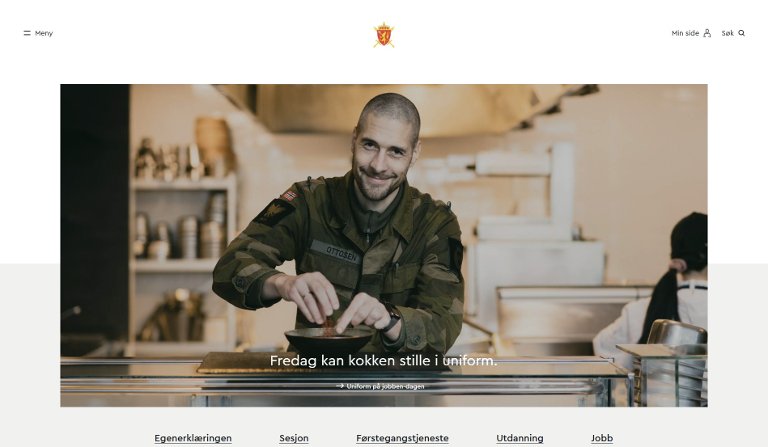
By 2019, its web presence spanned eight websites and approximately 7,000 pages, attracting more than 5 million visitors annually, around 70% of them on mobile devices. The audience was diverse, from young recruits and their families to veterans, media, and international partners.
Challenge: Legacy Systems and Fragmented Content
The Norwegian Armed Forces’ digital presence was built on SharePoint 2013, a platform approaching end-of-life and increasingly unable to meet modern expectations for usability, performance, and mobile experience.
Over time, several challenges had accumulated. The site carried significant technical debt, with custom front-end code making even small design changes dependent on developer resources.
Content quality varied widely across the roughly 7,000 pages, with some sections well maintained and others clearly outdated, undermining trust and credibility.
Navigation had become complex as multiple audiences were served through the same information architecture, forcing users to click through deep hierarchies to find relevant information.
This was particularly problematic given that the majority of visitors accessed the site on mobile devices, even though the platform was not designed mobile-first.
With young recruits increasingly relying on mobile to explore education and career opportunities, the Armed Forces needed a platform that combined speed, security, and editorial independence.
Solution: Choosing Enonic – a Platform for Editors and Developers
The Norwegian Armed Forces launched Project 4.0, an initiative to move away from fragmented, developer-dependent websites and towards a flexible, user-centric system for content teams that delivered fast, reliable digital experiences at scale.
The Armed Forces evaluated several platforms before selecting Enonic, built and hosted in Enonic Cloud.
The choice was driven by the need to balance editorial usability with enterprise-grade capabilities. The Armed Forces required a visual and intuitive editing experience for non-technical users, while still supporting structured content, complex integrations, and strong governance.
Security was also critical, and Enonic’s ISO 27001 certification and proven use across other public-sector organizations played an important role.
To deliver the new solution, the Armed Forces teamed up with Try for design and Enonic partner Bouvet for development.
Content-First Design and Rapid Collaboration
Rather than migrating old content directly into a new system, the team used Enonic to support a content-first, user-centric design process.
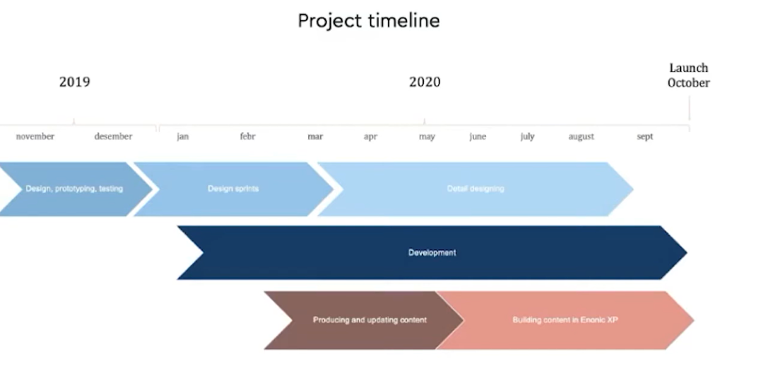
They ran two-week design sprints in which designers, developers, and editors worked closely together, building and testing prototypes directly in Enonic using real content.
This approach made it possible to evaluate navigation, structure, and editorial workflows early, long before full development.
Usage data helped the team prioritize high-traffic topics such as education, conscription, and recruitment, ensuring that the new structure reflected actual user needs rather than organizational silos.
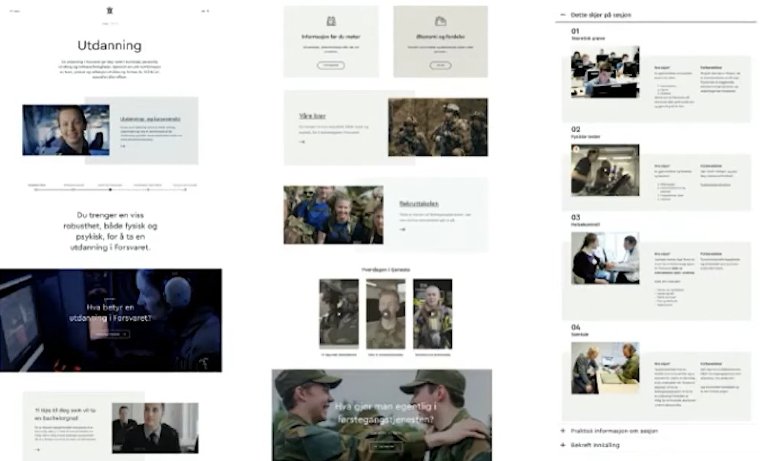
At the same time, the project coincided with a broader refresh of the Armed Forces’ visual identity. Enonic made it possible to implement a new design system that felt modern and authoritative, while remaining accessible and consistent across devices.
Redefining the Editorial Experience
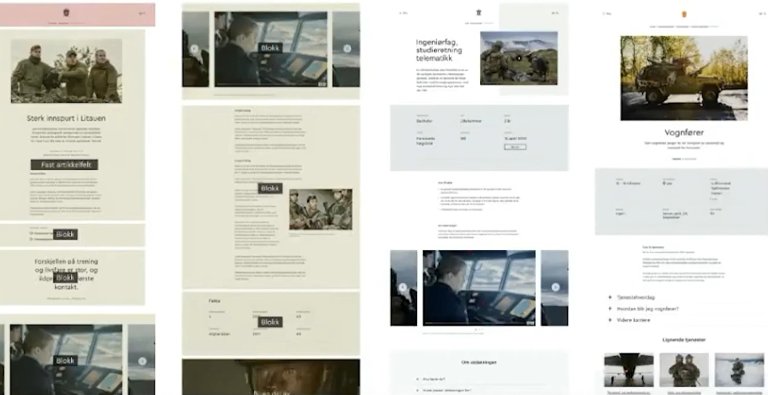
One of the most significant outcomes of the transition to Enonic was the editor experience itself. The new solution is built around simple, well-defined templates that are easy to understand and edit. Content editors can now build pages visually using drag-and-drop components and preview content across devices.
This made everyday publishing more efficient and less error-prone, reduced dependency on technical support, and created a better foundation for a large, distributed editorial organization to work consistently over time.
This balance between freedom and control is enabled through Enonic’s component model. For structured content such as news, research articles, press releases, and educational material, the team uses predefined blocks.
These are fixed templates containing a limited set of modules, such as rich text, fact boxes, videos, and accordions, ensuring consistency, accessibility, and brand compliance.
For more complex or high-impact pages, such as recruitment hubs and landing pages, editors use parts.
Parts are flexible components that can be combined freely to create unique layouts without breaking the overall design system.
Mobile-First Experiences and Smart Integrations
With mobile users as a primary audience, the Armed Forces introduced new components designed specifically for smaller screens.
Among these are mobile-friendly video stories inspired by Instagram, allowing users to swipe through short video segments, a format that has proven particularly effective for recruitment.
Enonic’s integration capabilities also played a central role. The new Forsvaret.no automatically imports job listings from the Webcruiter recruitment system and research publications from the CRISTIN database.
This removes the need for manual copying, keeps information consistently up to date, and ensures that content is reused across systems rather than duplicated.