When Everyone Can Create Content, What Becomes Valuable?
When everyone can produce well-formulated content in seconds, the question is no longer who can create the most. It becomes who actually has something to say.
Written by Morten Eriksen on
It has never been easier to produce content online. In April of last year, Ahrefs analyzed 900,000 English-language webpages that they had recently discovered on the web. Even then, 74 percent of the pages contained traces of AI-generated text.
The figure is not perfect, but the direction is hard to misunderstand. It has become very cheap to produce more. This can be useful, and we use AI ourselves for tasks that previously took an unnecessarily long time.
The problem arises when what is possible to produce also becomes what we choose to publish. Then we get more text, but not necessarily more knowledge. Much of the content is well-formulated, but at the same time strikingly similar. The same arguments, the same structures, and the same cautious conclusions.
We have worked with digital publishing since around the turn of the millennium. The cost of producing content has fallen dramatically. When something becomes cheap to produce, it also changes what has value.
Your Own Knowledge Becomes More Valuable
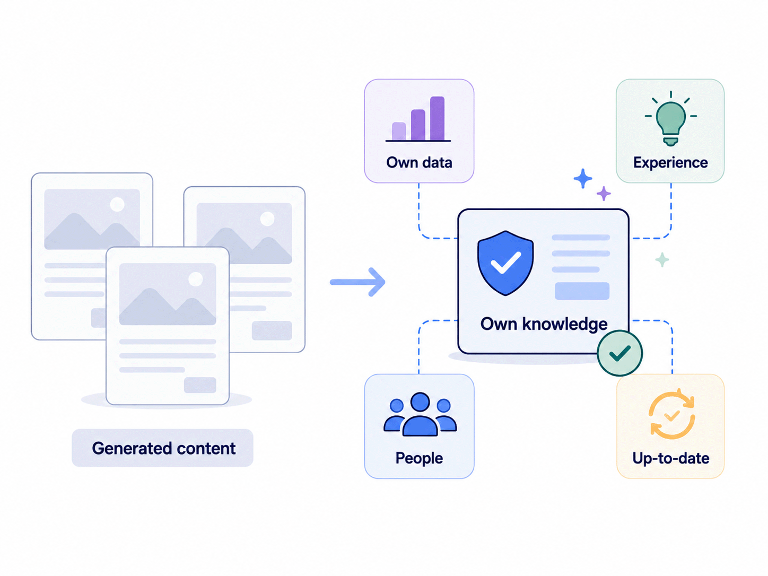
When anyone can produce large amounts of well-formulated text, the value shifts toward what others cannot easily generate. Your own data, experiences from actual projects, professionals who know why something works, and information that someone is responsible for keeping accurate and updated.
A general article about how a public benefit works is easy to create. But what the actual rate is, which deadlines apply, and when the money is paid out must come from someone who owns and manages that knowledge.
Take a public service like nav.no. That a rate or deadline is correct on one page is good. That the same information is correct everywhere it is used, even when regulations change, is something entirely different.
Then questions like which version is correct, who owns the information, and how it can be reused without having to be updated in multiple places become more important. This is not just content production. It is the management of truth.
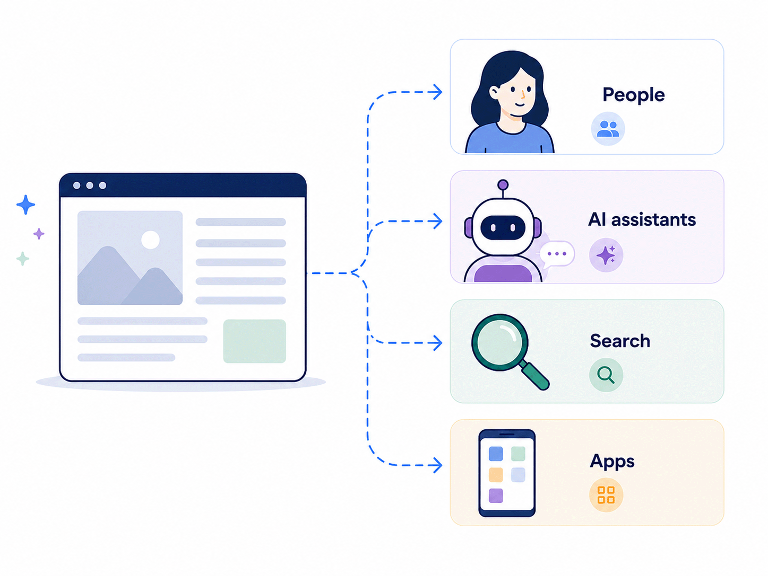
It requires a system that make it possible to manage information in one place and use it across websites, apps, and other services.
AI can reproduce, summarize, and explain information. But AI cannot be the authority on what is actually correct. That responsibility must lie somewhere.
The Website Gets New Readers
We have for a long time built websites with humans as the obvious recipient. Now, machines are joining them.
ChatGPT, Perplexity, and AI agents are already retrieving information from websites to answer questions and perform tasks on behalf of users. NRK recently wrote about how bots and AI agents now account for more than half of internet traffic, based in part on figures from Cloudflare. Not all automated traffic is AI, but the development illustrates how large a portion of the web is already being read by machines.
This means that content is increasingly being read and interpreted by a machine before it reaches a human. The website is therefore no longer just a collection of pages for humans. It is also a source of knowledge that search engines, AI services, and other systems try to understand and use.
Then some fundamental things become more important. Clear concepts, little unnecessary duplication, and clarity regarding which information is actually correct.
The more clearly a website expresses what the business knows, the less both AI services and humans have to guess.
Who Is Behind It?
When it becomes easier to produce credible text, the sender becomes more important.
Who is saying this? How do they know it? Have they actually done what they are writing about? And is there anyone willing to stand behind the claim?
For businesses, this makes their own experiences, clear positions, documented sources, and visible professionals more valuable.
This can be an advantage for smaller companies. They will rarely win the competition for who publishes the most. But they can know things others do not.
That is harder to mass-produce.
What Does This Mean for Us?
At Enonic, we have landed on three simple principles:
Manage before you create. More content also means more that must be quality-assured, updated, and managed. We believe in important content that can be reused and maintained, rather than an ever-growing mass of pages that say roughly the same thing.
Use AI, keep the responsibility. AI is a good tool for drafts, translations, summaries, and structure. We use it ourselves, and believe it is important to be open about how AI is used. But if Enonic has an opinion, someone at Enonic must actually hold that opinion.
Show where the knowledge comes from. Names, experience, sources, and responsibility become more important when generic content becomes cheaper.
AI is going to give us an enormous amount of content on the web. Some of it will be very good. Much of it will be just okay. But more content is not necessarily more valuable.
It also does not necessarily mean that businesses should produce less. On the contrary, more of the knowledge about products, services, and the business must be made available, and at a level of detail that works for humans, search engines, and AI agents.
The difference is that this knowledge must have a clear source, be able to be kept updated, and be used across platforms. That is the type of content that is actually worth reading, using, and trusting.

Morten Eriksen
Morten is the CEO and co-founder of Enonic. He has extensive experience as an entrepreneur focusing on areas like business development, product management, sales, and marketing. He started a digital agency in 1995 and built his first CMS in 1997, then founded Enonic in 2000 where his mission is to accelerate digital projects using innovative technology.